Product details description
Designing a guardrail for a multi-story car park is a high-stakes
engineering task focused on vehicular containment and pedestrian safety. The
primary standard (such as MASH or EN 1317) requires the rail to withstand
impacts from cars, SUVs, and pickup trucks at various speeds and angles. The
height is critical: typically 32 to 36 inches (80-90 cm) for vehicle containment
to prevent tires from rolling over, and an additional 42-inch top rail for
pedestrian fall protection. The concrete deck edge, where the post is anchored,
must be structurally sound; if the deck is old or spalling, the anchor bolts may
pull out under impact.
The material selection usually involves high-strength steel (A500 Grade B
or C) for the rails and posts. The steel must be galvanized or powder-coated to
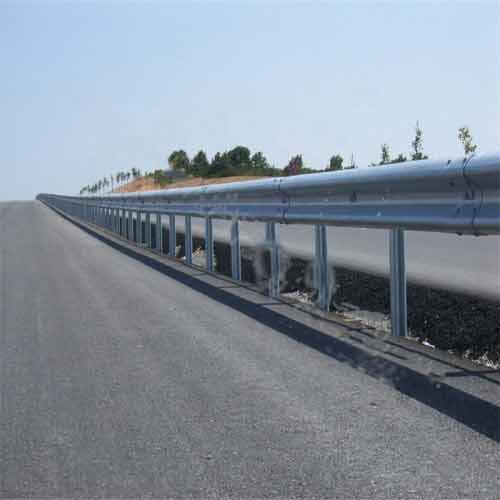
resist corrosion from road salts and weather exposure. The profile of the rail
is often a "W-beam" or a box section, which offers high moment of inertia to
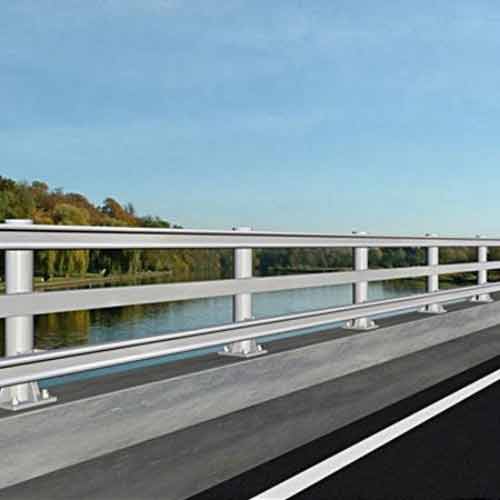
resist bending. For aesthetic car parks, architects may specify stainless steel
or aluminum with a brushed finish, though these are more expensive. The posts
are typically I-beams or heavy-duty square tubes, spaced 6 to 8 feet apart. The
spacing is a balance: too wide, and the rail deflects too much upon impact; too
narrow, and it becomes a hazard for opening car doors.
Energy absorption is a key design element. In tight spaces where a rigid
rail would transfer too much force to the building structure (or the vehicle
occupants), "breakaway" posts are used. These are designed to snap or bend at
the base upon a severe impact, absorbing kinetic energy and reducing the G-force
on the passengers. However, the rail must remain attached to the posts so it
doesn't spear the vehicle. This requires precise welding details and slip-base
connectors. Alternatively, "semi-rigid" rails use deformation of the steel tube
itself to absorb energy, offering a middle ground between rigid and flexible
barriers.
Concrete parapets are often integrated with the guardrail system. A "New
Jersey" or "F-shape" concrete barrier is frequently placed at the rail base to
prevent vehicles from under-riding the rail (a major cause of fatalities). The
concrete adds mass and redirects the vehicle back onto the roadway. The
transition between the concrete and the steel rail must be smooth to prevent the
vehicle from catching or flipping. Expansion joints are also vital; car parks
expand and contract with temperature changes. If the rail is continuous without
gaps or splice plates, thermal stress can buckle the steel or shear the
bolts.
Lighting and visibility are safety enhancements. The top rail often
incorporates LED linear lights to illuminate parking spaces and walkways.
Reflective tape or cat's eyes (retroreflectors) are mandated on the rail face to
make it visible to drivers in low light. In seismic zones, the connection
between the rail and the deck must allow for some sway without catastrophic
failure. This might involve oversized holes in the base plate or seismic
isolation bearings. Finally, the ends of the rail (the "terminal ends") must be
treated with impact attenuators (crash cushions) to prevent the rail from acting
like a spear if a car hits it head-on at an oblique angle.
Previous article:
Why Guardrails Are Essential on Highways
Next article:
Highway Guardrail - Ideal for Securing Highway Safety