Product details description
Installing guardrails along long-distance highways is a critical task that
demands precision engineering, strict quality control, and attention to terrain
challenges. These barriers protect vehicles and occupants from leaving the
roadway, mitigate crash severity, and guide drivers along safe paths in adverse
conditions.
Planning starts with route assessment. Engineers survey road geometry,
traffic volume, speed limits, and accident history to determine guardrail
placement and length. Terrain analysis identifies slopes, curves, and elevation
changes that affect barrier height and post spacing. Environmental reviews
ensure minimal disruption to waterways, habitats, and drainage systems during
installation.
Material selection focuses on high-strength steel, often galvanized or
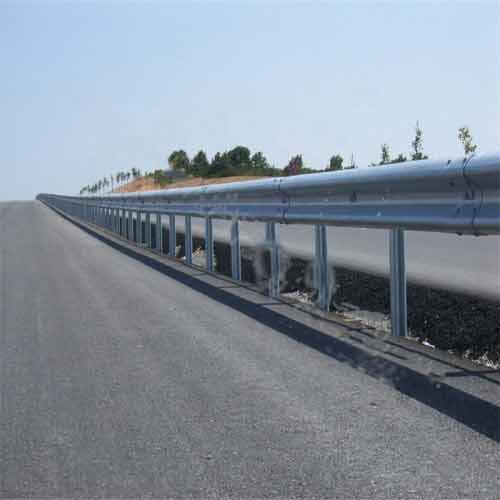
coated for corrosion resistance. Guardrail panels come in standardized profiles
(W-beam or thrie-beam) designed to absorb impact energy by bending and
redirecting vehicles. Posts—typically C-shaped or I-beams—are driven or embedded
to specified depths, with stronger foundations in soft soils or high-risk
zones.
Installation follows precise procedures. Panels are connected end-to-end
with splices, ensuring continuity and load transfer. Posts are aligned
perpendicular to the road surface, with proper embedment verified by depth
gauges and leveling tools. On slopes, offset posts or stepped installations
maintain barrier height relative to the roadway. Bolts and fasteners are torqued
to specification to prevent loosening under vibration.
Quality assurance includes post-installation testing. Impact simulations or
pull tests verify structural integrity, while visual inspections check
alignment, coating condition, and splice tightness. Adjustments are made for
settlement or shifting over time. In seismic regions, energy-dissipating devices
may be integrated to reduce earthquake-induced failures.
Long-distance installation also considers logistics and maintenance access.
Work zones are staged to minimize traffic disruption, and sections are numbered
for easy identification during inspections. Routine maintenance—checking for
deformation, corrosion, or loose hardware—extends service life. By combining
engineering rigor with adaptive field practices, highway guardrail installation
creates a dependable safety net for millions of travelers.
Previous article:
The Essential Role of Guardrails in Public Safety
Next article:
Highway Safety W-Beam Guardrail: Robust and Long-Lasting Design